Most people comparing AI voice tools start with the sticker price. But the pricing model — not the number on the page — is usually what determines whether you overpay. Here’s what actually changes between a subscription and a pay-as-you-go tool, and how to tell which one fits your workflow.
The Two Models, Side by Side
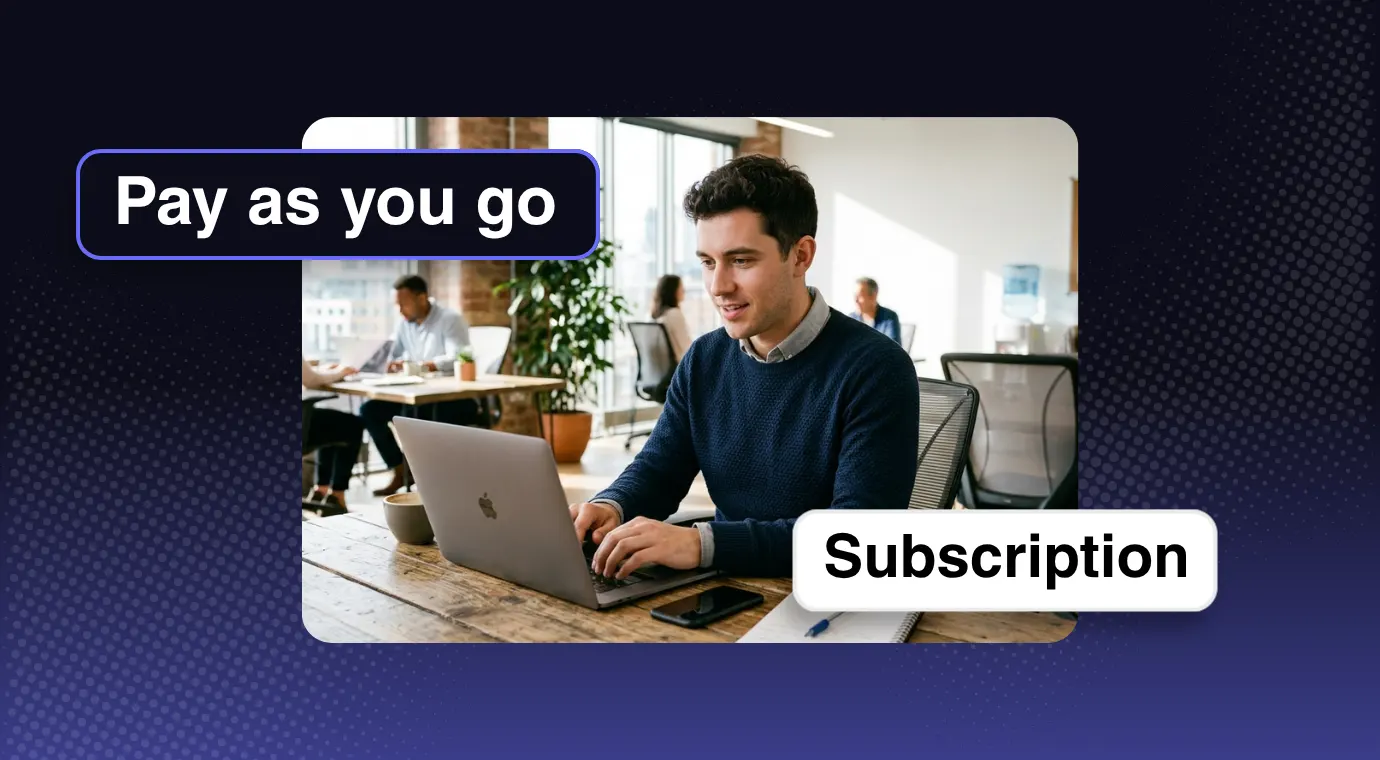
Subscription pricing charges a flat monthly fee for a fixed allowance — say, 30,000 characters or 24 hours of audio. You pay that amount whether you use 10% of it or 100% of it. Most platforms also gate features like voice cloning behind specific tiers, so the entry price often isn’t the price you actually need to pay to get the features you want.
Pay-as-you-go pricing charges per unit of actual usage — per character generated, per voice clone created. There’s no monthly minimum and nothing expires unused, because there’s no “unused” to begin with. You’re billed for exactly what you generated.
Where Subscriptions Make Sense
Flat-rate plans aren’t a bad model — they’re just built for a different kind of user. If your output is steady and high-volume — a daily podcast, a content team generating dozens of scripts a week — a subscription’s per-unit cost effectively drops as you use more of your allowance. At full utilization, subscriptions are often the cheaper option per script.
The tradeoff is rigidity: you’re committing to that volume every month, regardless of whether a given month is busy or quiet.
Where Pay-As-You-Go Wins
If your usage is inconsistent, seasonal, or just starting out, pay-as-you-go avoids the core problem with subscriptions: paying full price for a month you didn’t fully use. A freelancer who generates 5 scripts one month and 40 the next pays roughly proportional to what they actually did, instead of guessing which tier to commit to in advance.
It also removes a second hidden cost: tier-gating. On many subscription platforms, voice cloning specifically requires upgrading past the entry plan. With pay-as-you-go pricing, cloning is usually just another per-unit charge — no separate tier to unlock.
How VoxlyLabs Approaches This
VoxlyLabs runs entirely on pay-as-you-go pricing — what you use is what you pay, full stop. There’s no subscription tier to choose, no monthly allowance to track, and no feature locked behind a higher plan. Text-to-speech is billed at $0.04 per 1,000 characters and voice cloning at $0.25 per clone, both billed only against actual usage.
This matters most if your AI voice usage doesn’t look the same every month. You’re not deciding in advance how much you’ll need — you’re just paying for what you generate, when you generate it.
See What Your Usage Actually Costs
The only way to know which model fits you is to compare it against your real numbers, not a hypothetical. Try VoxlyLabs and generate your next script to see exactly what it costs — no plan to pick, no tier to commit to.
Quick Decision Guide
- Steady, high-volume output every month? A subscription’s effective per-unit cost may end up lower.
- Inconsistent or seasonal output? Pay-as-you-go avoids paying for capacity you don’t use.
- Need voice cloning without committing to a higher tier? Pay-as-you-go usually prices it as a standalone unit, not a tier gate.
- Want a predictable bill regardless of usage? A subscription gives you that certainty — at the cost of flexibility.
Frequently Asked Questions
What's the difference between pay-as-you-go and subscription AI voice pricing?
Subscription pricing charges a flat monthly fee for a fixed usage allowance, regardless of how much you actually use. Pay-as-you-go pricing charges only for the characters generated or voices cloned, with no monthly minimum.
Is pay-as-you-go cheaper than a subscription?
It depends on volume. For low or inconsistent usage, pay-as-you-go is typically cheaper since you’re not paying for unused capacity. For steady, high-volume usage, a subscription’s per-unit cost can work out lower.
Does VoxlyLabs offer a free tier?
No — VoxlyLabs is pay-as-you-go only. There’s no free tier or trial credits; you pay only for what you generate, at $0.04 per 1,000 characters and $0.25 per voice clone.
Why is voice cloning often locked behind a higher subscription tier?
Many providers treat cloning as a premium feature to encourage upgrades, bundling it into mid-tier or top-tier plans rather than pricing it separately. Pay-as-you-go models typically avoid this by pricing cloning as its own per-unit charge.
Can I switch between pricing models on the same platform?
Some providers offer both a subscription and a metered/overage option. Platforms built entirely around pay-as-you-go pricing, like VoxlyLabs, don’t require choosing a tier in the first place — usage is billed the same way regardless of volume.